
HR Survey Results: Key Challenges, Internal Organizational Development Research Practices, and Barriers

HR Survey Results: Key Challenges, Internal Organizational Development Research Practices, and Barriers
The role of Human Resources (HR) has progressively moved beyond an administrative framework to acquire strategic significance over recent decades. Organizations are now focused not only on efficient workforce management but also on enhancing the Employee Experience (EX) and fostering a healthy, development-oriented environment.
However, international studies—including the McKinsey’s HR Monitor 2025—indicate that many companies still struggle with:
- Attracting and retaining talent;
- Long-term workforce planning;
- Systemic and data-driven management of the Employee Experience.
This global context naturally raises questions about the local reality:
- To what extent does the situation in Georgia align with these global trends?
- What are the most significant challenges for local companies?
- How do organizations study and assess these challenges?
- How do companies plan internal organizational research, and what are the practical barriers cited by HR professionals?
To address these questions, ACT Research conducted a survey with HR representatives from organizations of various industries and sizes.
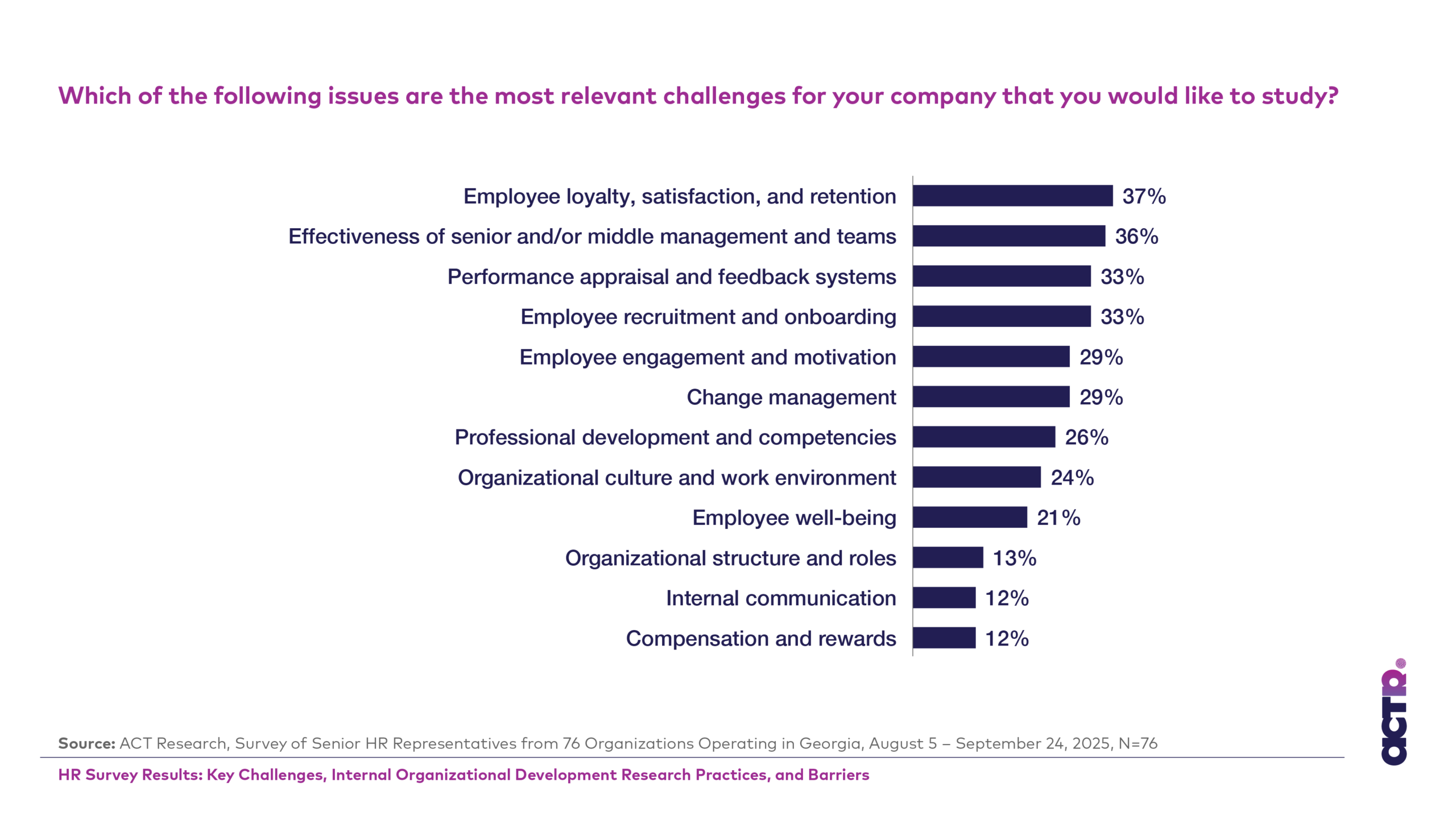
Major Challenges
According to the HR professionals surveyed, the three most significant challenges are primarily concentrated around Employee Experience, Employee Retention, and Management Effectiveness.
The research data clearly shows that company scale (number of employees) significantly determines the prioritization of HR challenges.
Smaller-scale companies (1–100 employees): The main challenges are Organizational Culture and Work Environment, and Performance Appraisal and Feedback Systems. This is likely due to limited resources, a lack of formal HR processes, and fewer structural processes. In smaller companies, the employee experience often relies more on personal, direct relationships than structured systems.
Larger companies (100+ employees): Challenges manifest at a more strategic and systemic level, focusing on Employee Loyalty, Satisfaction, and Retention, Upper/Middle Management and Team Effectiveness, and Employee Recruitment and Onboarding. This scale involves more complex structures and diverse teams, which complicates management and talent retention.
Internal Organizational Research Practices
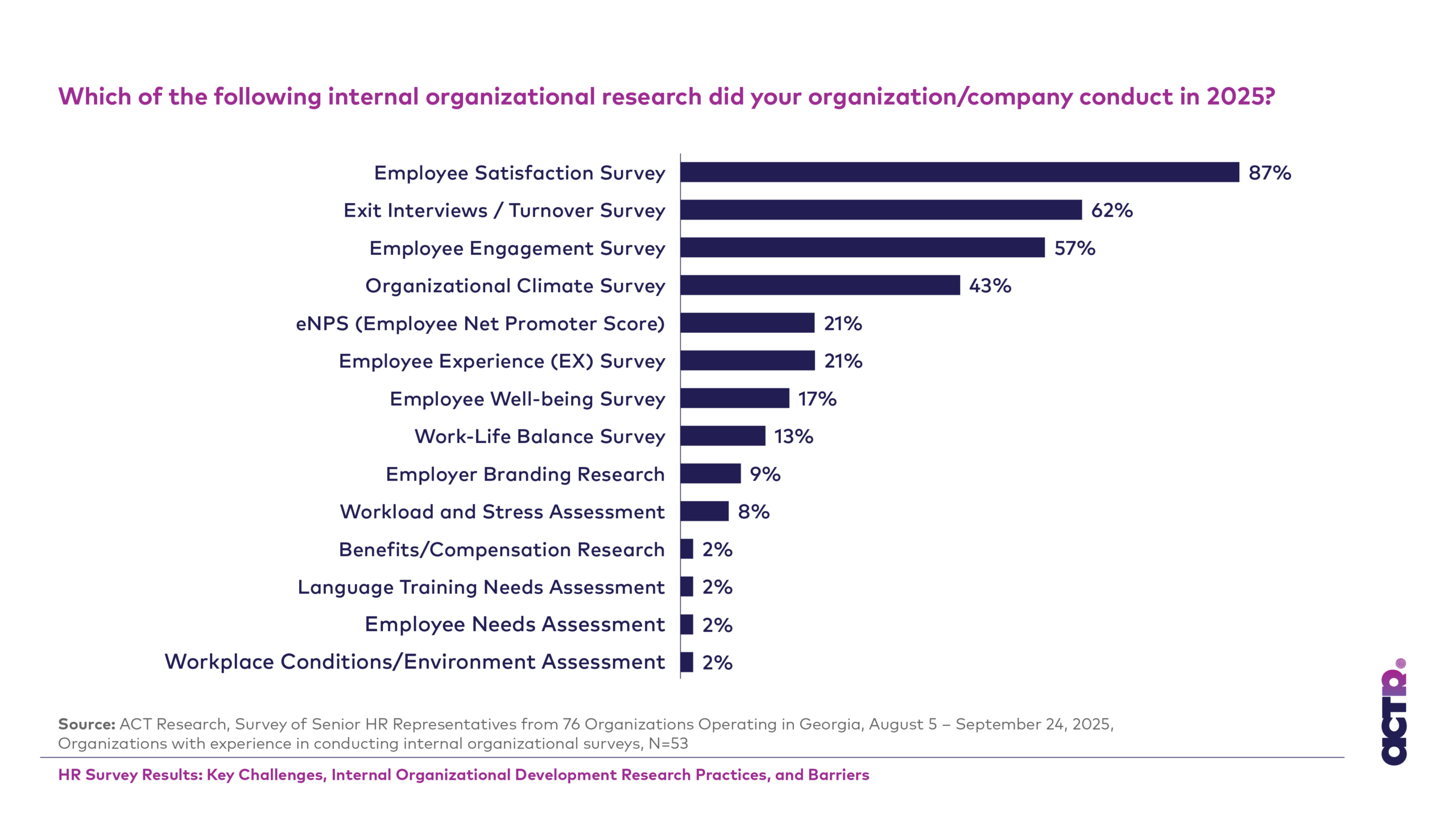
70% of surveyed companies have experience conducting internal organizational research within the last year.
Most of these organizations perform studies regularly, with only 15% reporting it as a one-time initiative for a specific need.
These organizations actively research and assess core HR indicators—Employee Satisfaction, Engagement, and Reasons for Leaving—which are crucial for operational efficiency. However, research is less utilized for specialized areas such as Employee Wellbeing, Stress, Overload, and Work-Life Balance.
Industry experts suggest that focusing on these issues enables companies to implement innovative, employee-centric EX initiatives, which in turn helps in talent retention, enhanced engagement, and organizational effectiveness.
Barriers to Internal Organizational Research
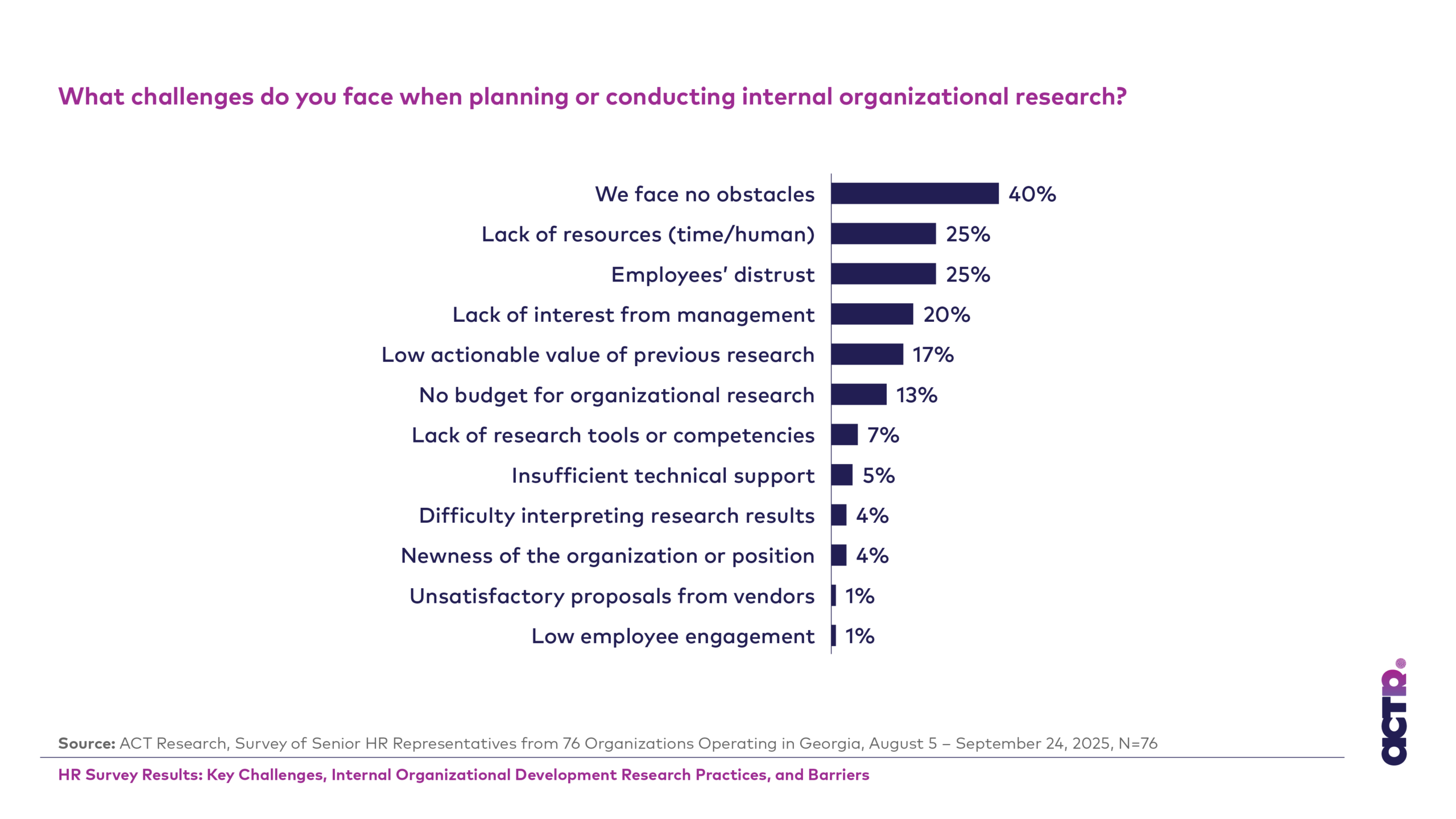
40% of the surveyed companies report facing no barriers to conducting internal organizational research (this is particularly evident in large-scale companies with 100+ employees).
However, significant obstacles were identified that could lead companies to forego research:
- Lack of time and human resources
- Employee distrust (of the research process)
- Lack of management interest
For successful HR initiatives, a methodologically sound study is not enough; critical factors include management involvement, employee trust, and the availability of appropriate time, human, and financial resources. Internal organizational research is a primary tool for both problem identification and driving actionable solutions. Organizations must be ready to execute the subsequent actions.
The survey also revealed that 81% of organizations conduct internal research using their own resources, suggesting a preference for accessible and practical solutions. Yet, HR professionals concurrently mention the lack of employee trust in the research.
These two results may indicate a potential bias: when the organization itself conducts the research, employees may not fully perceive its anonymity and objectivity. As a result, using internal resources is flexible and economical, but there is a high risk of partially subjective data, which ultimately impacts the quality of HR decision-making.
Internal Organizational Research: The Foundation for Practical and Positive Change
The ACT Research study confirms an active practice of using internal organizational research, often powered by in-house resources, which underscores its importance to companies. However, the full potential of this instrument is not yet being realized.
To ensure that research data doesn’t remain merely a report but is transformed into real, practically applicable changes, the following are essential:
- Correct integration of research into HR processes
- Regular, non-one-off monitoring
- Fostering employee trust in the research process
- Active management involvement
These steps are what will transform internal organizational research into a prerequisite for enhanced employee engagement and organizational effectiveness.
* The online survey on HR challenges and internal organizational research practices was conducted from August 5 to September 24, 2025. Participation included high-ranking HR representatives from 76 organizations operating in Georgia.
This study was conducted at the initiative of the company “ACT Research” (ACTR) within the framework of its Corporate Social Responsibility (CSR) program, under the rubric “Voice of Business”.
ACTR’s CSR policy is based on an approach focused on public well-being and the generation of timely, evidence-based data to better understand societal issues. To this end, ACTR periodically conducts public opinion research in four main areas:
“Voice of Society” – studying social and civic attitudes;
“Voice of the Consumer” – analysis of consumer behavior and needs;
“Voice of Business” – research on private sector trends and expectations;
“Digital Trends” – monitoring technological and digital changes.
The goal of the initiative is to improve access to data and promote informed, public interest–based decision-making in both the private and public sectors.
ACTR ensures data transparency and accessibility – as one of the key mechanisms for creating public value.